
As healthcare and life science companies search for innovation hubs, Omaha is making a compelling case as a place to launch, grow and scale.
At the center of that story is the EDGE District, a health-focused innovation district anchored by the University of Nebraska Medical Center (UNMC). Designed to accelerate the commercialization of healthcare innovation, the EDGE District brings together researchers, clinicians, entrepreneurs, startups, industry partners, investors and service providers into a collaborative ecosystem that helps move ideas from discovery to real-world impact.
“Today’s healthcare innovators are looking for much more than real estate,” said Amy Thompson, director of campus development for the EDGE District and UNMC. ” They’re looking for an ecosystem that provides access to every resource needed to move ideas from discovery to market.”
Omaha’s EDGE District is More Than Buildings

The EDGE District was intentionally designed as much more than a research park or another mixed-use development.
Physical space is only one component of a broader health sciences innovation ecosystem designed to foster collaboration, accelerate commercialization and support company growth by intentionally connecting the right people, organizations and resources.
“The most successful innovation districts create opportunities for people from different disciplines and organizations to connect, collaborate and solve problems together,” Thompson said. “The buildings are important, but they are only the beginning.”
Innovation districts like the EDGE District have emerged as a growing global model for accelerating economic development by intentionally bringing together academia, healthcare, corporate R&D, startups, entrepreneurial support organizations and industry within dynamic, mixed-use environments. Innovation districts anchored by an academic medical center — like the EDGE District and UNMC — play an especially important role by driving research, commercialization and company growth.
Catalyst Omaha, a 170,000-square-foot innovation hub, serves as the front door to the EDGE District’s ecosystem. In addition to housing UNeMed, UNMC’s technology commercialization office, the building is home to startups, entrepreneurs and innovation-focused organizations spanning healthcare, diagnostics and medical devices.
Just as importantly, Catalyst brings together a broader network that supports innovation. As a mixed-used development home to Big Grove Brewery & Taproom and Big Grove Coffee Co., Catalyst fits into the neighborhood, brings in community members and creates informal opportunities for connection.
Complementing Catalyst is CORE (Center of Research Excellence). A six-story, 180,000-square-foot mixed-use research and development facility, CORE will expand the district’s capacity with flexible wet lab and dry lab spaces, offices and amenities.
EDGE District is also developing entrepreneurial programming and commercialization support designed to help companies successfully navigate the path from innovation to market.
Access to Talent, Research and Commercialization Support

For companies considering expansion or relocation, Omaha offers access to a unique combination of research, clinical expertise and collaborative partnerships that can be difficult to find elsewhere.
UNMC generates a steady stream of discoveries, patents and startup opportunities, and the university’s technology commercialization office, UNeMed, is there to turn promising research into products and services by connecting with entrepreneurs and established companies.
That combination of resources is tough to find elsehwere, said Michael Dixon, president and CEO of UNeMed. And Nebraska’s cost structure can significantly extend a company’s runway.
Describing a conversation with a biotech entrepreneur who relocated from California, Dixon recalled: “You give me $5 million in San Francisco, it lasts me six months. You give me $5 million here in Nebraska, it lasts me 16 months.”
Beyond affordability, companies benefit from nationally recognized clinical expertise, translational research capabilities, specialized core facilities and a healthcare community that is unusually collaborative and accessible compared with many larger markets.
For many companies, that combination can significantly accelerate both innovation and business growth.
“You can get all the great things about living in the middle of the country – low cost of living, great schools – with world-class facilities at UNMC,” Dixon said. “You can access globally recognized core facilities, clinical research expertise, and the resources you need without paying the big-city price of places like San Francisco or Boston.”
EDGE District Offers a Collaborative Ecosystem

For entrepreneurs already working in the EDGE District, one of the biggest advantages is its collaborative culture.
Evan Luxon, CEO of Teucer Diagnostics, operates from Catalyst and has experienced firsthand the benefits of being surrounded by other health technology companies and innovators.
“It just feels like a team sport in the sense that everyone is building this ecosystem together,” Luxon said. “The sense of the community has been really good. Everyone is very willing to help out, make connections and act as a sounding board.”
That collaborative spirit is one of the themes Thompson heard repeatedly while developing the EDGE District’s strategic plan. As part of that process, she spoke to entrepreneurs who had built companies both in Nebraska and in some of the nation’s largest innovation hubs.
“A consistent theme emerged,” Thompson said. “Nebraska offers something increasingly difficult to find in larger markets. Leaders are accessible, organizations genuinely collaborate, and entrepreneurs can more easily connect with the people, expertise, capital and strategic partnerships needed to accelerate growth.”
Dixon sees the same dynamic throughout the region.
“It’s collaborative,” he said. “We’re not competing with each other.”
Creating a Front Door to Innovation
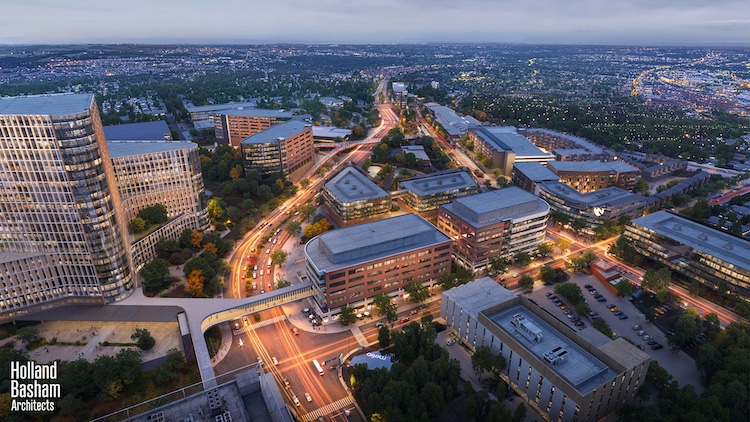
Rather than keeping research and innovation behind institutional walls, the EDGE District is creating a visible and accessible front door to the region’s health sciences innovation.
“Innovation doesn’t happen in isolation,” Thompson said. “By intentionally co-locating research, entrepreneurship, industry, investment and support organizations, the district creates opportunities for the collisions and connections that often lead to breakthrough ideas, new companies and long-term economic growth.”
The EDGE District’s leaders believe Omaha is uniquely positioned for continued growth, combining the strengths of a leading academic medical center with a collaborative innovation ecosystem, entrepreneurial support, commercialization resources, affordability and an exceptional quality of life. Together, those advantages create an environment where healthcare innovation can move more quickly from discovery to real-world impact.
For healthcare companies evaluating where to invest, expand or establish partnerships, Omaha offers something increasingly rare: the research capabilities, clinical expertise and commercialization resources of a major innovation ecosystem without the costs and barriers associated with larger markets.
“Omaha offers the capabilities of a major healthcare innovation ecosystem with the accessibility, collaboration and agility of a much smaller market,” Thompson said. “As the EDGE District continues to grow, our goal is not simply to attract companies. It’s to build a community where innovators can connect, collaborate and accelerate the future of healthcare together.”
What Makes the EDGE District Different?
• 30-acre development adjacent to the University of Nebraska Medical Center, an academic medical center campus in the urban core of Omaha
• A collaborative healthcare innovation ecosystem designed to accelerate commercialization
• Access to UNMC research and clinical expertise
• Technology commercialization support through UNeMed
• Flexible co-working, office and wet lab space; entrepreneurial programming and strategic partnerships